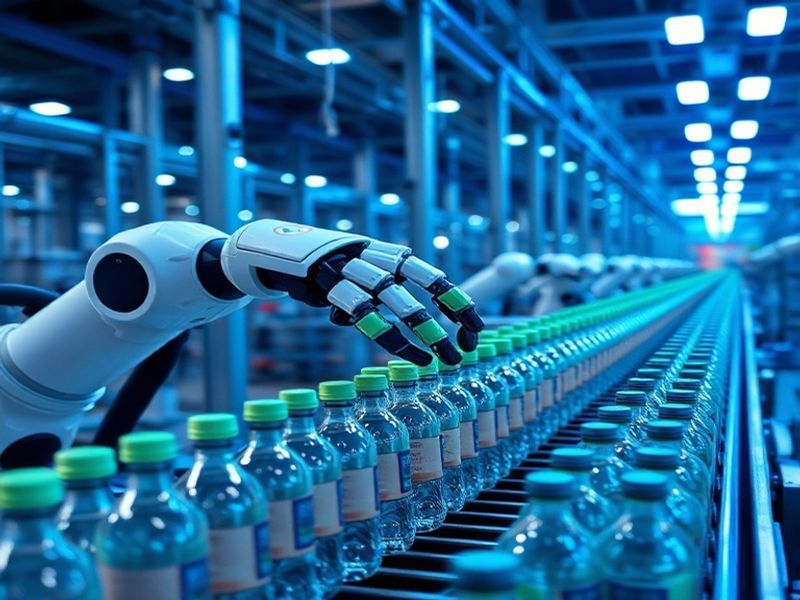
In 2025, the field of plastic crushing and recycling machinery is ushering in a technological revolution led by Artificial Intelligence (AI), automation, and the Internet of Things (IoT). Traditional mechanical recycling is transforming towards intelligence and refinement to cope with increasingly complex waste plastic streams and strict requirements for high-quality recycled materials.
Deep Integration of AI and Robotics
In the modern recycling factories of 2025, AI-driven intelligent sorting systems have become standard. These systems use advanced computer vision and deep learning algorithms to identify and separate waste plastics of different materials, colors, and even brands with near-human accuracy. For example, industry-leading AI vision systems achieve 99% purity in the sorting of PET and HDPE streams.
Moreover, intelligent robotic arms are gradually replacing manual sorting. They work tirelessly, performing hundreds of picking actions per minute, greatly improving sorting efficiency and reducing operating costs. This human-machine collaboration model is redefining productivity standards in recycling factories.
Intelligent Upgrade of Crushing Technology
As the core of the recycling line, plastic crushers are also undergoing intelligent upgrades. The new generation of crushers has built-in sensors that can monitor motor load, bearing temperature, and tool wear in real-time. Through IoT modules, this data is transmitted to the cloud in real-time, allowing managers to grasp equipment status at any time via mobile apps.
More importantly, the intelligent control system can automatically adjust rotor speed and torque according to the material and volume of the feed to achieve the best crushing effect and energy efficiency ratio. This adaptive control not only extends equipment life but also reduces energy consumption by 20%-30%. For Processing complex materials, such as high-strength engineering plastics or large lumps, intelligent crushers demonstrate incomparable advantages.
The Rise of Chemical Recycling Equipment
In addition to mechanical recycling, innovation in chemical recycling equipment is also a highlight of 2025. Addressing mixed plastics and multi-layer composite films that are difficult to handle with traditional mechanical methods, Pyrolysis and Depolymerization technologies offer new solutions. Miniaturized and modular chemical recycling devices are emerging, which can be deployed in communities or small recycling stations to achieve local Processing of waste plastics.
Green Equipment and Energy Efficiency Revolution
Guided by the "Dual Carbon" goals, equipment manufacturers are paying more and more attention to the full lifecycle carbon footprint of their products. The plastic machinery of 2025 adopts high-efficiency energy-saving motors (IE4/IE5 standards) and regenerative braking technology. At the same time, noise reduction equipment has reached new heights. Through fully enclosed soundproof enclosures and active noise reduction technology, the operating noise of many heavy-duty crushers is controlled below 85 decibels.